

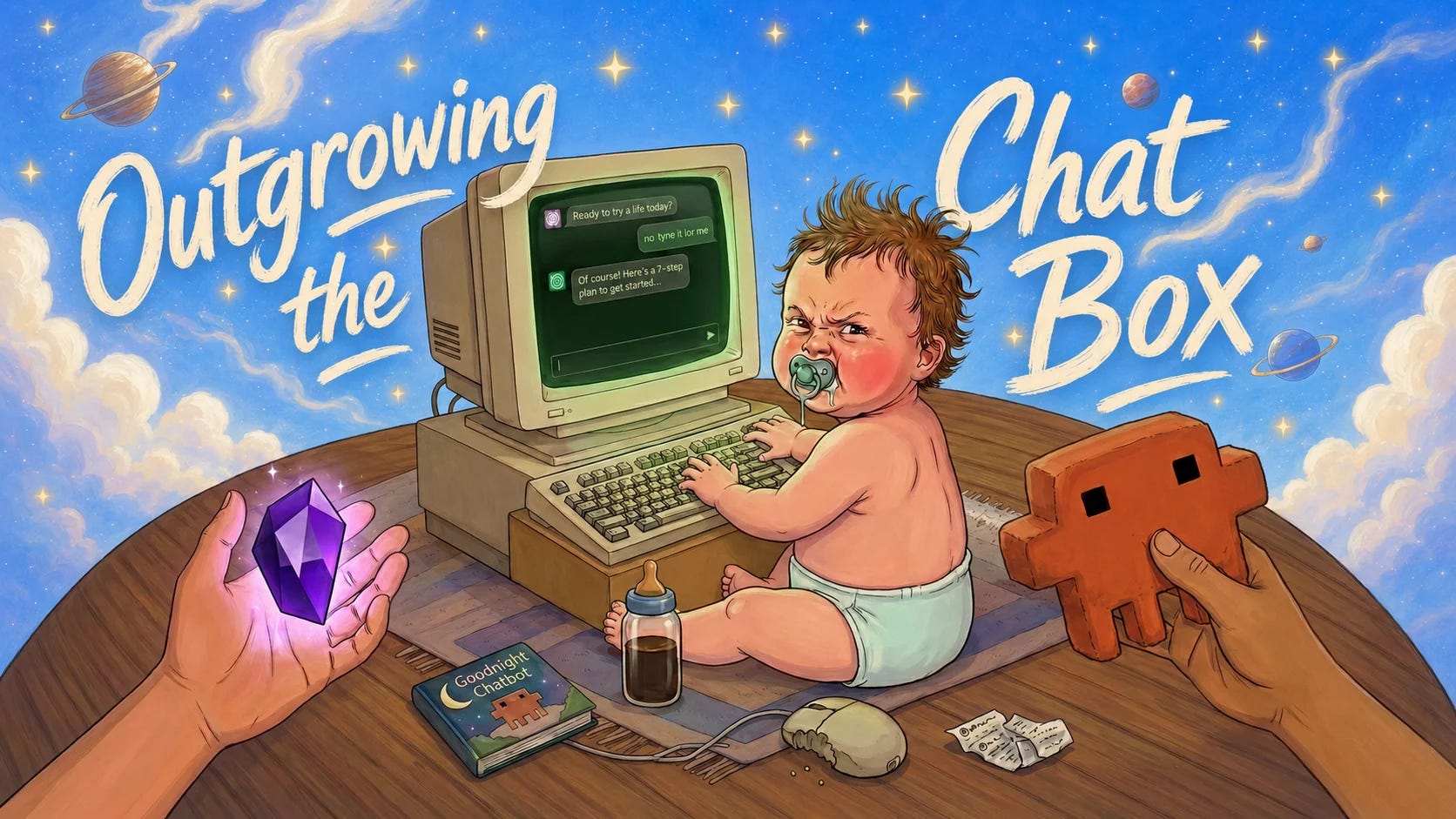
I barely open a chat anymore.
Like many, I left chat-only interfaces for agentic ones months ago. In AI time, that’s ancient history. I switched from Claude Chat to the Claude Code + Obsidian combo, and it paid off better than I expected.
This is how I work now, and how I get there.
The shifts
Setting up the tools takes an afternoon. That part’s easy. You need the tools, but that’s not the shift. The real shift is in the attitude and habits they pull you into.
1. Switch the setup
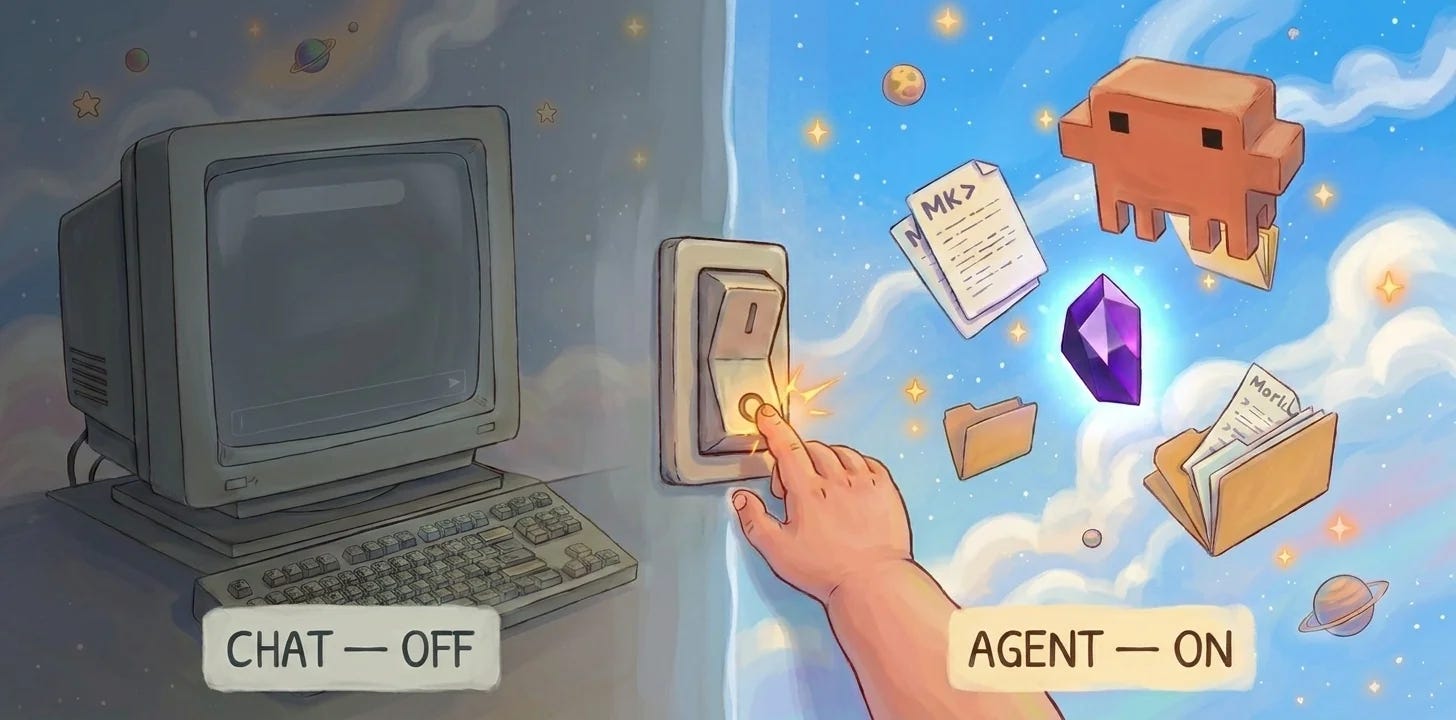
It starts with the setup. Mine went from Claude Chat to Claude Code + Obsidian.
They’re coding agents. They create files, take action. They don’t just talk back.
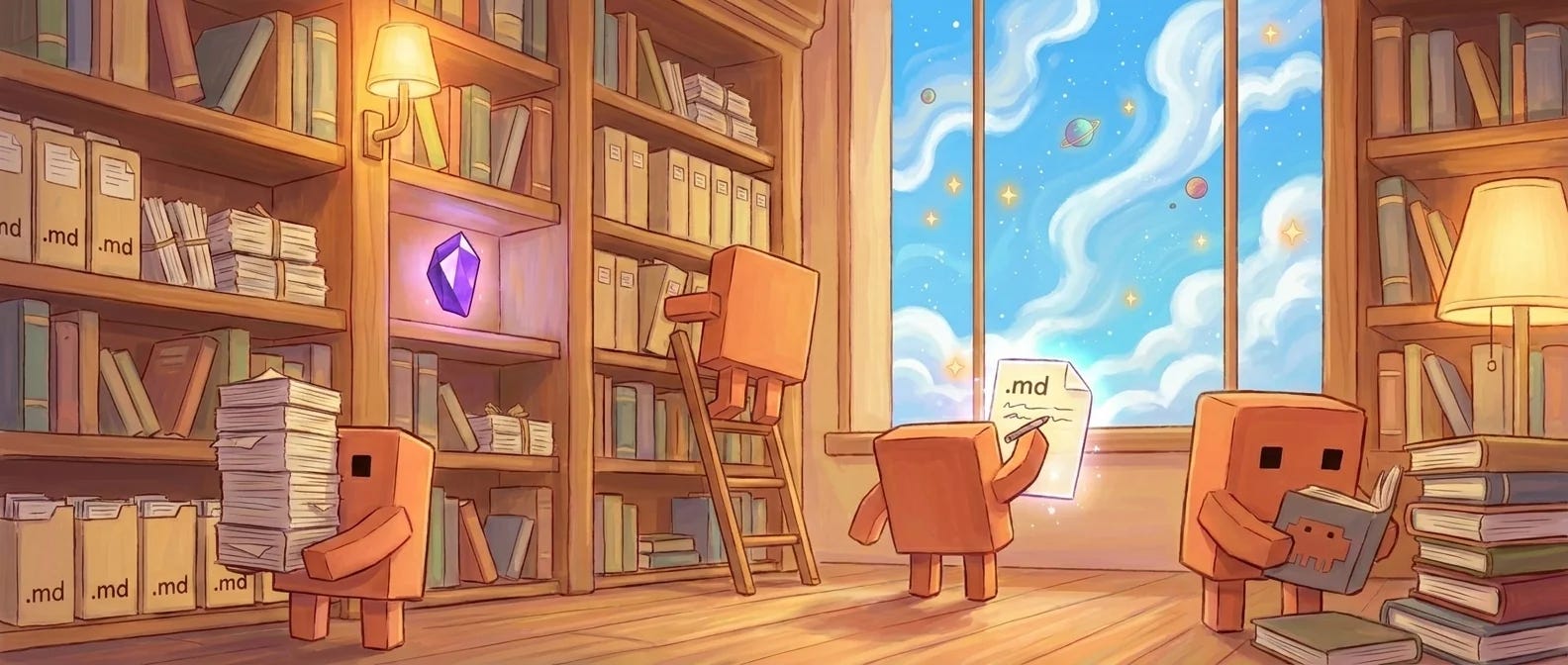
Everything lives in one folder, my homebase for all my creative and knowledge work. The files are mostly Markdown. Each project is a subfolder. Say I start an illustrated storybook (a little fox who’s afraid of the dark), and a storybook/ folder fills with .md artifacts as the agent and I work. That storybook is the running example I’ll carry through the rest of this piece.
That folder is shared ground. Claude Code and Obsidian both point at it. I run a few Claude Code sessions, in the terminal or the desktop app, whichever, and read and edit the same files in Obsidian. It’s just my file view; I skip the linking.
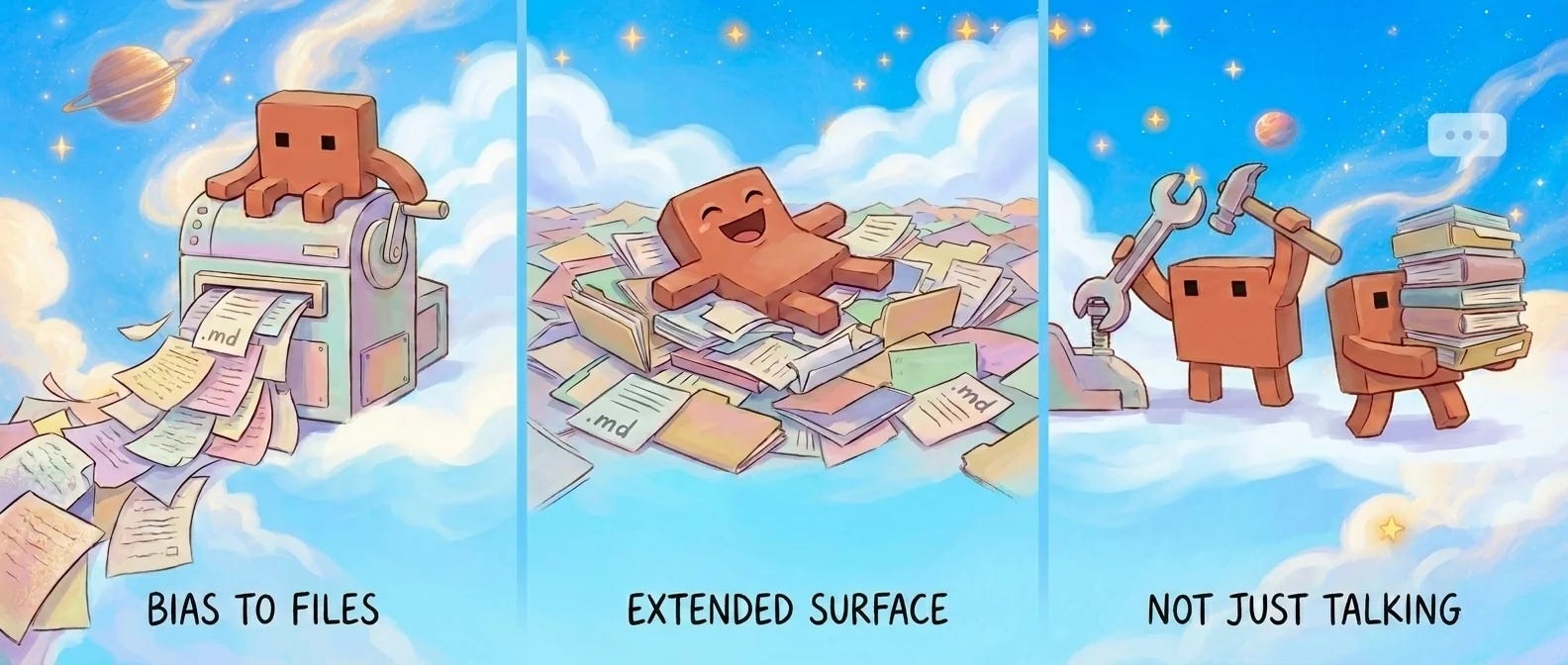
The setup enforces three things:
A bias to creating files. They’re designed to read and write files and run commands, so they default to making files. That alone changes how you operate.
An extended surface. The chat isn’t the only place you work. Input and output aren’t trapped in the chat anymore. They extend into files and folders. You type into the chat less; you write, edit, and read in files instead.
Not just talking. There’s still a chat, often several. But the work shifts to delegating tasks, shaping the input and context, and reviewing the output. For the storybook, one session develops the story and characters while another draws the pages I’ve already written. It’s like a small crew working with me on the same shared context and files.
2. Think in files
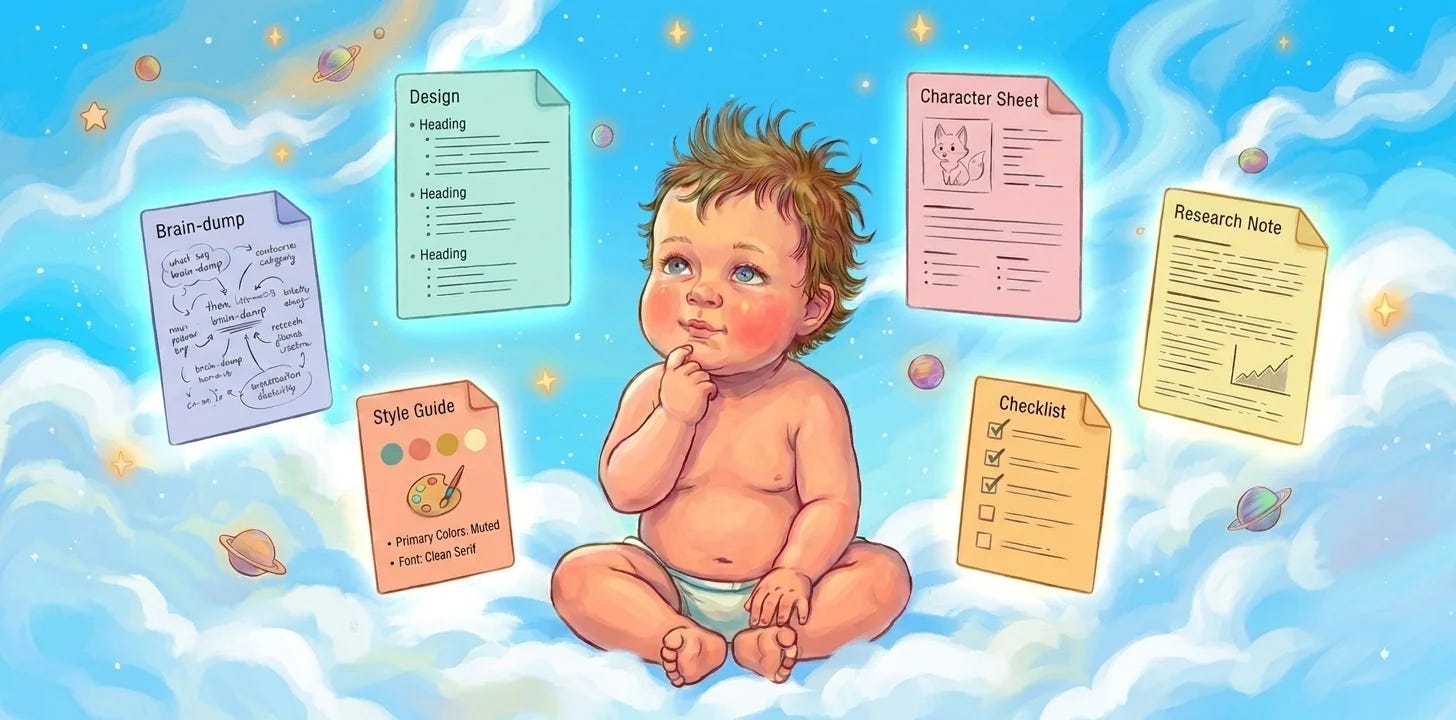
The work lives in files now. I keep all of them in Markdown, just plain .md files. It gives the text a light structure (headings, lists, formatting, the occasional table), and editors like Obsidian handle it well. But it isn’t just plain text. A file has a type, based on its content and structure. It might be a brain dump, a research note, a design doc, a spec, a character sheet, a prompt template.
Every document takes its own shape, with a type, an outline, and content of its own. And it plays a role, working as a reference in context, or as the input or output of a process. Same .md, different documents.
I want to called them artifacts, a piece of my AI vocabulary now. To me, every .md file is an artifact. I shape it, name it, keep it, and it lives in the folder, not on the chat surface.
Plenty of them aren’t keepers. They’re intermediate or temporary, made to think with, like a braindump, a list of options, a scratch plan. Those move the work as much as the finished pieces.
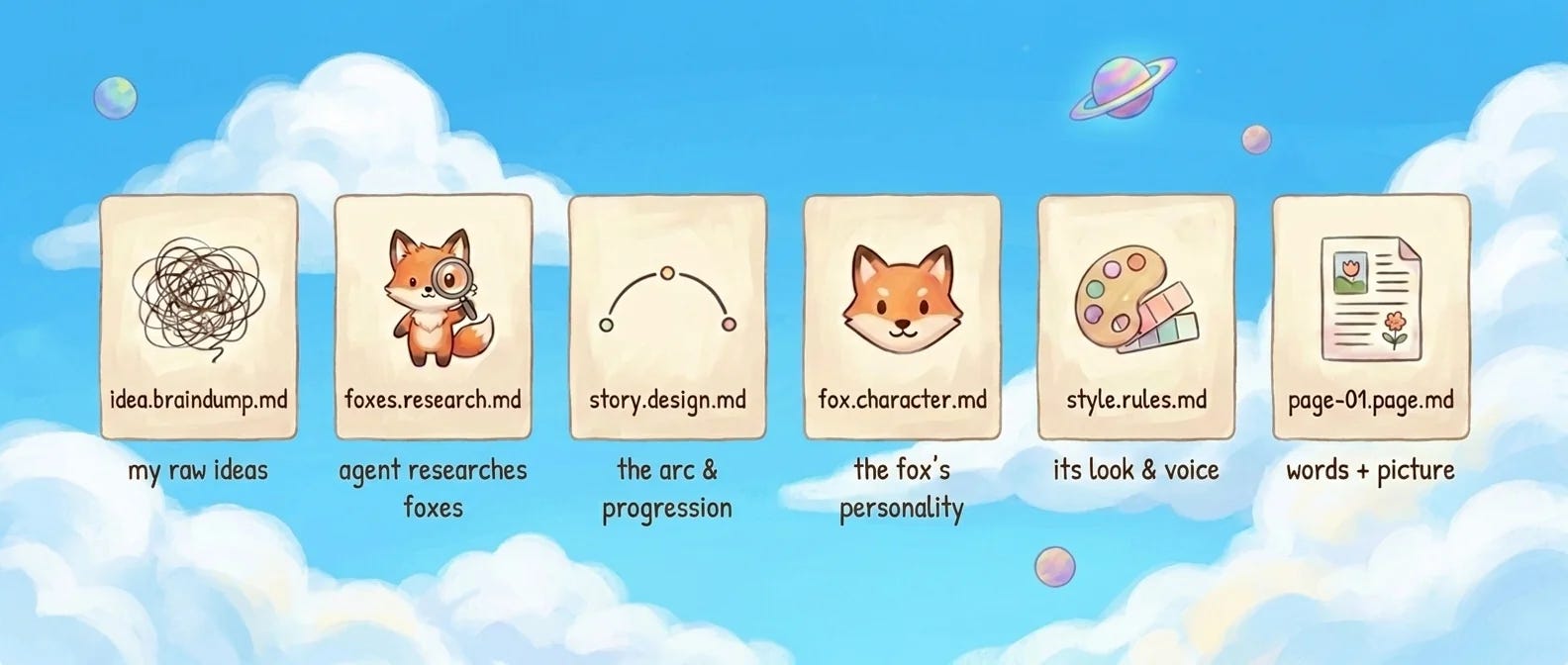
Take the storybook. It grew these files one at a time, as the work needed them. Each is named for its type:
idea.braindump.md— the raw first dump: the fox, the dark, the feeling I’m after.foxes.research.md— what real foxes are like, and the bedtime books I want it to feel like.story.design.md— the arc: scared fox → the turn → brave fox; page by page.fox.character.md— the fox herself: shy, curious, big ears. She feeds the pictures.style.rules.md— the soft, warm look and voice every page holds to.page-01.page.md— one page: its words and its picture. (I make more of these than anything else.)
The name carries the type, like .braindump, .research, .design, .character, .page. Each holds its own few sections inside. And they feed each other. Research feeds the character; the character, the plot, and the style become the story; and the story loops back to shape the fox. All of it becomes the pages. Then I refine, and pull it together.
I don’t force a rigid type or form, though. I don’t pre-define what sections, format, or language each kind of document must have. The words carry their own weight. Natural language is the most dynamic, versatile tool we’ve got. Keep it that way.
3. Reach for tools
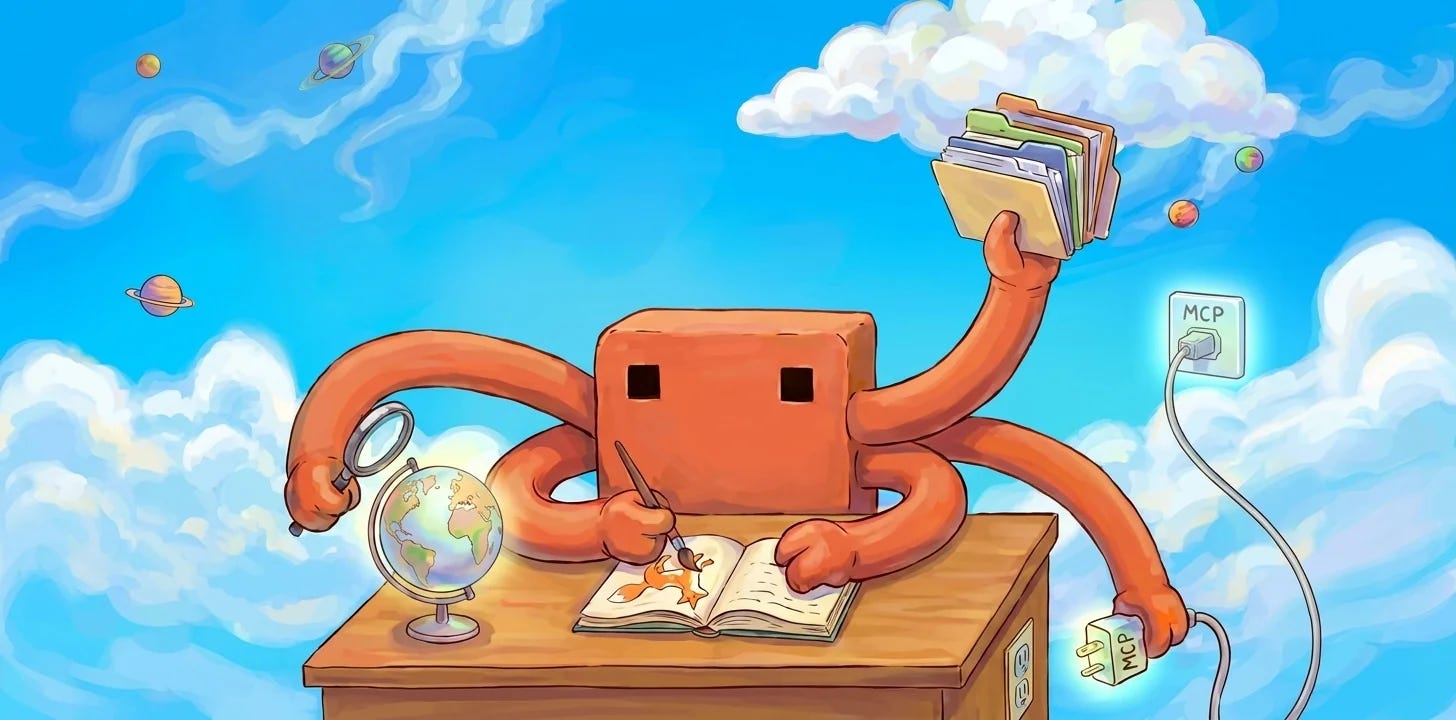
The agent doesn’t just write files. It calls tools, and it connects to what you already use. This is a big one.
It searches the web and drops the findings into foxes.research.md. It pulls in files you already have from Google Drive or your email. For the storybook, it calls an image model to draw the fox and her dark forest, then writes a quick script to shrink the file sizes without touching the images, checks the result, fixes what’s off, and saves them in the same folder. And on like that, as far as you want to take it.
These are tool calls. The agent decides it needs something, reaches for the right tool, and folds the result back into the work. And you’re not limited to what’s built in. MCP (the Model Context Protocol) is the standard plug for wiring in your own. Connect a tool or service once, and it’s there from then on.
The more you connect, the more it does for you, and you never have to leave the folder.
4. Build a system
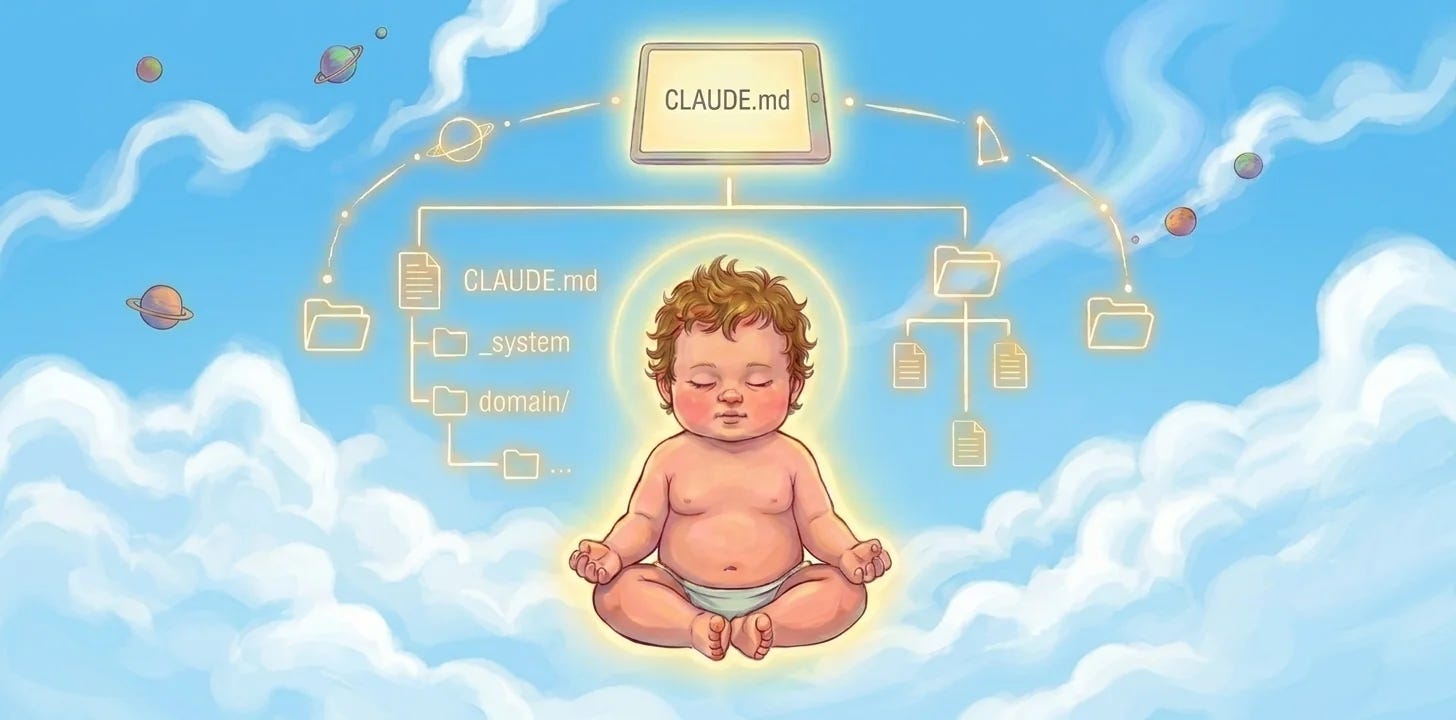
Files and artifacts need a structure. The human and the AI need a shared model to work in. In short, you need a system.
Luckily, the agentic tools hand you the way to build one. It’s a context file called Claude.md (or agent.md), the prompt that’s always there, where you set how things work.
Here’s the gist of mine, shortened from the file at the root of my homebase (the full version is in the repo):
# Homebase

The one folder where everything I make and learn lives, mostly Markdown. Each project is its own domain, its own folder.

The mental model is simple. Thinking happens in files. The chat steers; the files are
the work.

## How we work

- **Parallel sessions.** A few agents on a shared folder; I steer from the editor.
- **Two surfaces.** Align in chat, make the work in files (~20/80, adjustable).
- **Think in artifacts.** Every file has a type and a role; even scratch files count.
- **My input is sacred.** My taste and direction are the source of truth.
- **Respect my time.** Concise and dense, no fluff.
- …

## Structure

CLAUDE.md       — what this is, how we work, the rules
_system/        — shared tools, scripts, conventions
domainA/        — one folder per project, its own domain
  CLAUDE.md     — per domain context, its name, what it is and why, how it works, its guides, do's and don'ts
domainB/        — e.g. a storybook, a game, a blog
domainC/        — e.g. a research vault, a course
Look at those rules. Parallel sessions, Two surfaces, My input is sacred. Simple lines, but they make a huge difference.
The storybook is just one of those domains, with its own folder and its own CLAUDE.md holding the fox’s world and the book’s style.
It starts lean and grows as I work. It gets opinionated, it becomes mine.Skills.md is another piece some lean on; I use it lightly, but mostly I’d rather improvise.
5. Build context and momentum
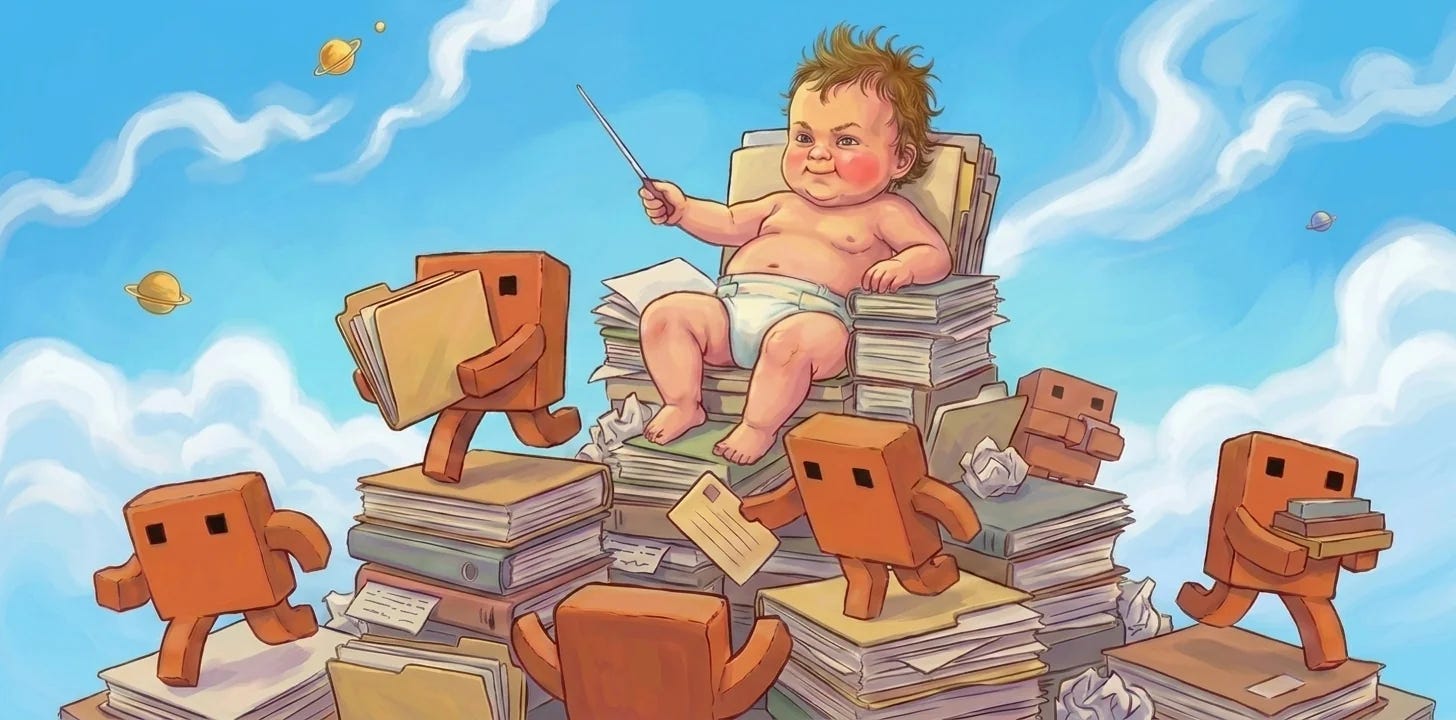
I don’t think of this as chatting with a machine that just passed the Turing test.
The work becomes building context incrementally and finding momentum in the right direction.
I build context by gathering more of those .md artifacts. Direction and momentum emerge as I instruct and judge, as I add my tokens, my taste, and my opinion. It isn’t a vibe or a snapshot; it’s an arrow that sharpens with every bit of input. It builds, it speeds up, it points.
Take the storybook. It starts with almost nothing, just a fox, the dark, a feeling. I open idea.braindump.md and dump it, fast and raw. The agent diverges and brainstorms off it; then we converge, researching the foxes, designing the arc, drafting the first page. Each step leaves an artifact, and the context thickens.

The first page is slow. I’m finding the look and the voice at the same time. By the fifth, the forest is set, the fox is herself, the style holds, my intent is sharp, and I know where it’s going. Each new page comes fast. I’m not starting over, just adding to a book that already knows what it is.
The catch

There’s inertia at the start. It’s a cognitive shift, and it was hard to switch. The old habit had opinions.
But once the habit forms, the payoff is huge. The tools fade into the background. What stays is a different way of thinking, one that lives in files, in systems, in momentum. You won’t miss the chat box.
If you want to work this way, my homebase is one context file to drop in: github.com/nnehdi/homebase.